Field note 05 · retail activations
Jersey personalization inside a retail pop-up.
A pop-up is not a small store and it is not an event, and personalization inside one behaves like neither. You are operating in borrowed space, on someone else's rules, for a fixed residency, with a footprint that has to be struck and rebuilt more than once. It is a good format for this work — a press lane is the single most convincing reason to walk into a temporary shop — but it rewards planning in ways a plaza activation does not.
What the pop-up format changes
You are a tenant, not a producer
Mall concourses, host stores, and short-lease units all come with a rulebook: load-in windows through service corridors, floor protection requirements, restrictions on what may be plugged in, sometimes limits on heat-producing equipment, and a fire marshal's opinion about aisle width. Every one of those is answerable, and every one of them takes a week longer to answer than anyone expects. We ask for the venue's operating requirements at the same time as we ask for the dates.
There is no back-of-house
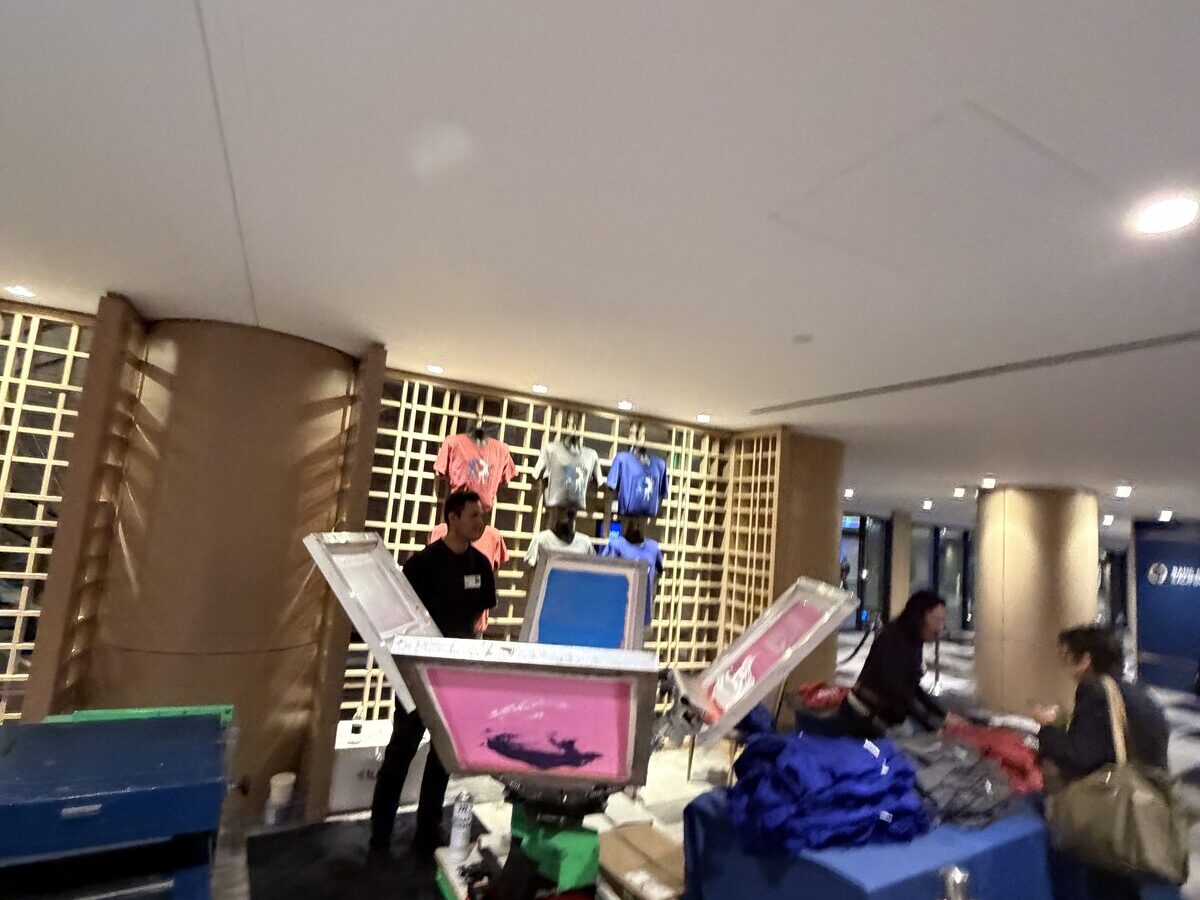
A pop-up rarely has a stockroom. Inventory, transfer stock, and staging all have to live inside the same footprint the customer is standing in, which is why pop-up builds run compact — commonly one or two lanes with the intake tablet at the head of the counter and staging behind a low fixture rather than in another room. We survey the space and mark the footprint in tape before the first shift so nobody discovers the queue crosses a fire exit on opening day.
It is struck and rebuilt
Most residencies require equipment to be secured or removed nightly. That is a real cost and it belongs in the plan rather than in a surprise. Where the venue allows a locked overnight, the build stays up and the morning is a twenty-minute recalibration. Where it does not, budget the teardown and rebuild into the staffing figure — staffing bills at $250 per hour across setup, live time, and teardown, and doing that seven times over a week is a very different line item from doing it once.
Inventory: cap it, and cap it in the tablet
Pop-ups sell through unevenly. Mediums and larges go first, the extremes linger, and by day three the size curve looks nothing like the one you ordered. Two habits handle it.
First, set per-size caps in the intake tablet so a size that has sold out disappears from the picker rather than being offered to someone who has already queued. Sourced blanks stock adult XS–3XL, and the cap is a setting, not a sign taped to a counter. Second, review the size report at the end of each trading day rather than at the end of the residency — a mid-residency restock is possible if you know on day two and impossible if you find out on day six.
If the garments are yours rather than ours, the same principle applies to the counted-in stock, and the daily count matters more because there is no replenishment lever at all.
Tie the ticket to the transaction
In retail the sale and the personalization ticket should be the same record. The customer pays for the garment and the decoration together, and whatever reference that transaction generates is entered on the ticket at the tablet. It takes seconds and it settles almost every dispute before it starts, because there is always a paid transaction attached to a press job. It also gives the brand a clean daily reconciliation: units sold, units personalized, reprints, and remaining stock by size.
Staffing a residency rather than a day
Retail hours are long and demand is lumpy. A ten-hour trading day is not two five-hour activations; the crew has to be rotated, and the peak is usually a two-hour window somebody in marketing can predict better than we can. Ask them. Then staff for the peak and accept quieter hours, or run a single lane through the quiet trading period and add a second only for the known peak — both are legitimate, and the second is often cheaper than people assume.
Where traffic is genuinely unpredictable, the ready-text option is worth its cost: the customer gets a message when their jersey is done and keeps shopping instead of holding a position at the counter. In a pop-up, floor space occupied by a standing queue is floor space not selling anything.
What to send us for a pop-up quote
- Dates, daily trading hours, and whether the build can stay up overnight.
- Venue name, floor plan or dimensions, and the operating requirements document.
- Power available at the position, and the distance to it.
- Garment source — yours or sourced — plus brand, style, and size curve.
- Expected daily units, and any known peak window.
- Whether the personalization is included in the garment price or sold separately.
That is enough for us to come back with a lane count, a crew rota across the residency, the load-in plan, and a written figure. Travel is $0 inside Orange County, Los Angeles, and San Diego and $900 outside that footprint, which for a multi-day residency is usually the smallest number on the page.
The in-store retail build → Roster or walk-up intake → Pricing inputs →
Next step
Planning a pop-up residency this season?
Send garment source, unit count, venue, and hours on the floor. We reply with lane count, crew size, and a written figure.