Home / Deployments / Stadium and arena activations
Deployment type C
Stadium and arena jersey personalization, built for an open queue.
Concourse space is fixed, load-in is a window not a day, and demand arrives in a spike. A build that works at a corporate lunch will fold under that. Here is how the stadium version is different.
Queue engineering, not press speedC.1
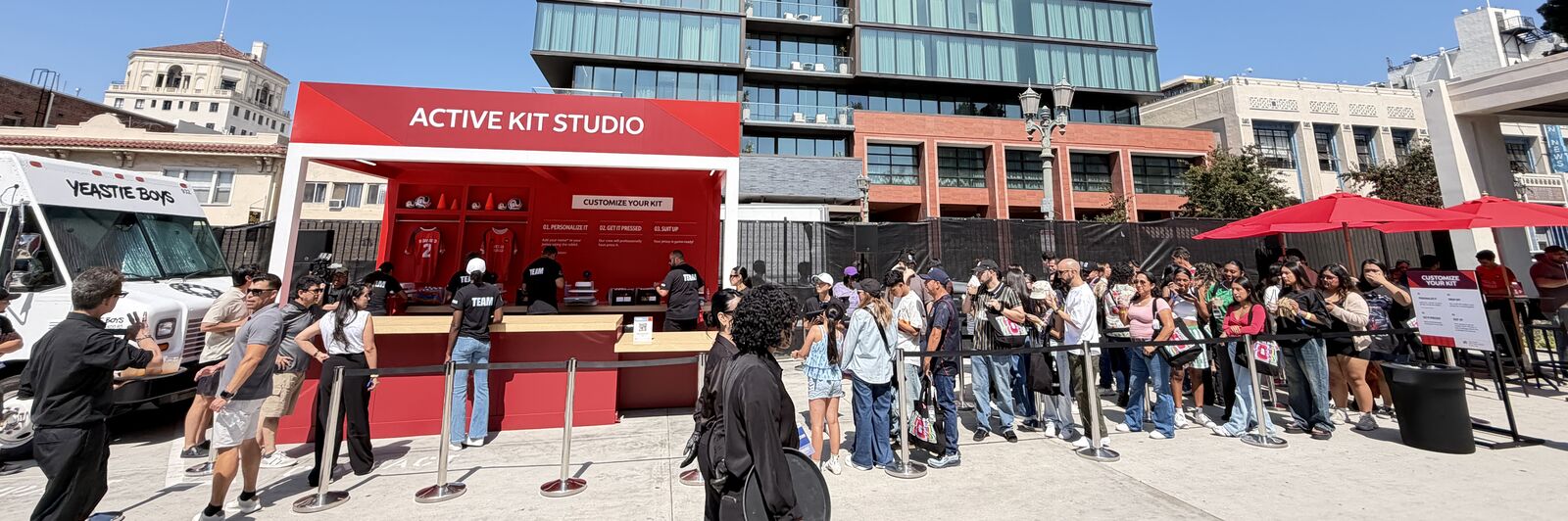
At venue scale the limiting factor is almost never how fast a press closes. It is how fast decisions get made and how work is distributed. Merch Troop crews have run this format at outdoor sport activations with hundreds of guests queuing, including a red kit-studio build with locker bays, tablet stations, and a dedicated pressing crew — and the lesson from those builds is consistent.
Tablet stations sit ahead of the press counter, so guests are entering names while jerseys are already pressing. Each entry becomes a numbered ticket. Tickets are distributed to lanes by least-pending-work rather than in rotation, which stops a single awkward job from stalling one whole side of the build. The crew works a shared queue board, so a lane falling behind is visible immediately and gets a second pair of hands instead of a growing backlog.
Four lanes is the usual answer at this scale, with one operator per lane, and large activations scale further.
Venue constraints we plan aroundC.2
Load-in windows
Venues give a window, not a day, and it is often before dawn or between events. Presses need to be placed, powered, heat-soaked, and test-pressed inside it. We plan setup as billable, scheduled work and confirm dock access, cart routes, and elevator dimensions in advance rather than discovering a freight lift is too small at 5am.
Power and heat
Each lane draws real current, and a concourse circuit is shared with things you cannot trip. We give the venue a load figure per lane during planning so the electrician assigns circuits properly. Presses also throw heat, which matters in an enclosed concourse and affects where the queue is allowed to form.
Egress and sightlines
A jersey queue is a physical object and it grows. It cannot cross an egress path, block a vomitory, or wrap in front of a concession. We agree the queue's shape and maximum length with venue operations in planning, and the crew lead holds the line to it on the day.
Premium tiers
For suite holders, club members, and VIP programs, guests can be texted when their jersey is ready rather than standing in the queue. At a stadium this is not a luxury feature — it is a footprint decision. Fewer standing bodies means a smaller queue envelope, and a smaller queue envelope means venue operations approves the build.
Garments, sizes, and the spikeC.3
Sizes stock adult XS through 3XL and are capped per size in the intake tablet. When the last XL is claimed, XL disappears from the guest's picker. That single behavior removes the worst moment in a live line — a guest waiting twenty minutes to be told the size they chose is gone.
Demand at a venue is not flat. It spikes at doors, at halftime, and hardest after a result. We plan lane coverage against the event clock instead of averaging across the day, which means shift-planning the crew and, on some builds, opening additional lanes for a defined window rather than staffing them for eight hours.
If your program supplies its own jerseys, the same handling rules apply as everywhere else: fabric test on samples from the lot ahead of the date, counted in at load-in, counted out at teardown, damage documented same-day.
Stadium build reference
- Lanes
- 4, scaling up
- Intake
- Tablet, ahead of counter
- Distribution
- Least-pending-work
- Sizes
- XS–3XL, capped live
- Premium option
- Ready-text pickup
- Travel
- $0 in OC/LA/SD, $900 outside
Next step
Concourse build on the calendar? Send the load-in window.
Send garment source, unit count, venue, and hours on the floor. We reply with lane count, crew size, and a written figure.