Section 1.5 · service detail
Heat-applied numbers: on-site jersey numbering as a contracted service.
Numerals applied with a full-color transfer and a heat press, at your venue, on your garments or ours. The specification, the press variables, and what the line item includes.
What the service is1.5.1
Heat-applied numbering is the application of a numeral — and usually a name above it — to a finished garment using a printed transfer and a controlled press cycle. The transfer is cut and printed ahead of the press; the press bonds it to the fabric under a set temperature, dwell, and pressure.
It is the default method on live work for two reasons: it holds on the slick, textured, and mesh polyester used across modern jersey construction, and the cycle is short enough that a lane keeps pace with a queue.
Color is unrestricted. A two-tone outlined numeral, or a sponsor mark alongside it, costs no additional pass and no screen — there are no screens. That matters on programs where the numeral style changes between home and away sets.
Numeral specification
- Digits
- 1–3 per garment
- Locations
- Back, front, sleeve
- Color
- Full color, outlines included
- Name above
- ~9 characters max
- Typeface
- Client file or menu, locked pre-event
- Registration
- Collar and side seams, per size
- Garments
- Yours or sourced, XS–3XL
The three press variables1.5.2
Every argument about heat application comes back to three settings, established per lot rather than assumed from a datasheet.
What the fabric tolerates
High enough to bond, below the point where polyester glazes or yellows. This is the setting that scorches a garment when it is guessed, and it is the first thing the pre-event sample test establishes.
How long it stays down
Too short and the bond fails at the edges once the garment cools. Too long and you are back to glazing, or you reactivate a sublimated graphic underneath and get a ghost shadow next to the new numeral.
How hard it presses
Enough to seat the transfer into a textured or mesh surface, not so much that the knit is crushed and left with a visible platen impression around the numeral.
Why we test the lot, not the style
Two jerseys with the same style number can take heat differently because they came off different mills. Samples from the actual production lot go under the platen before the date, and the resulting numbers go onto the run sheet. A lot that fails is declined before a pallet ships.
Geometry, sizes, and the size run1.5.3
A jersey back is a fixed canvas with two occupants: the numeral owns the middle, the name sits above it, and both must clear the collar taping and shoulder seams. Front and sleeve numerals are smaller and specified separately — a program that says "add numbers" and means back, front, and both sleeves has quadrupled a press count without saying so.
Numeral height is confirmed on a pressed proof, because a height that reads well in a drawing can sit wrong against a particular collar. Once approved, the geometry is locked into the intake tablets. Placement is then adjusted per size rather than applied as one measurement across the run: a position correct on a small rides high on a 3XL, and marked platen positions per size keep a set of jerseys looking like a set.
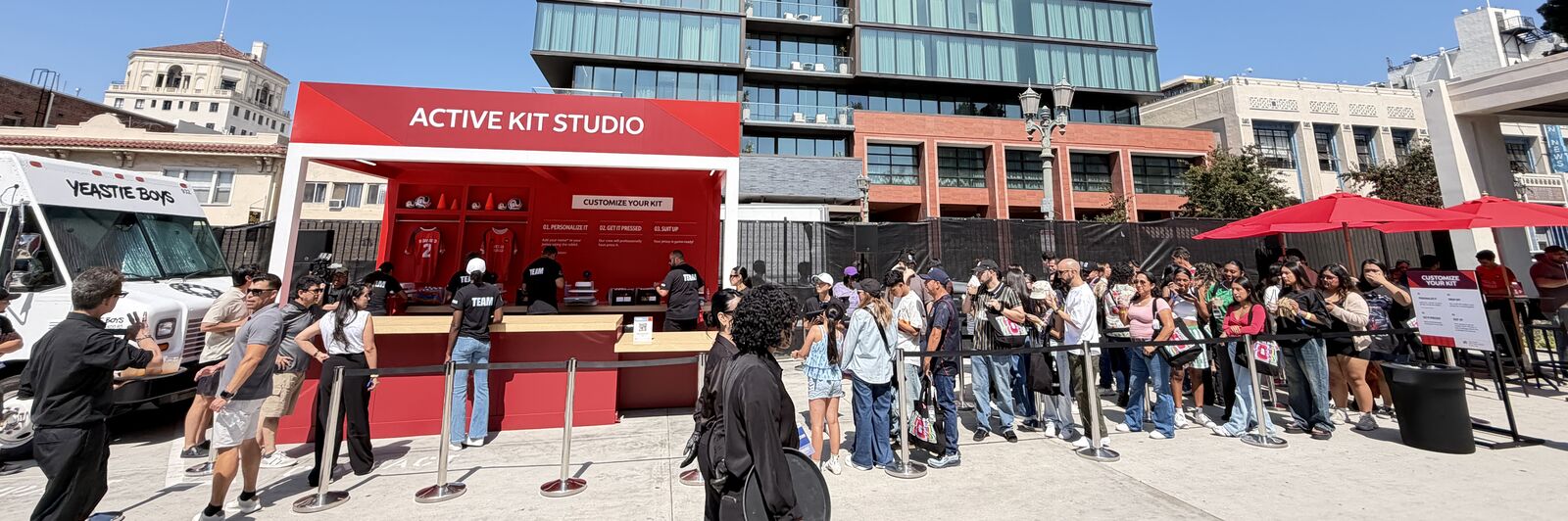
How it runs on the day1.5.4
Ticket
A roster line or a guest entry becomes a numbered ticket at a tablet: number, name, size, colorway, and location. Character and digit limits are enforced at entry so a layout problem never reaches a press.
Distribute
Tickets go to lanes by least-pending-work, so one awkward job does not build a backlog. Crews scale one press to one operator, with most builds running between two and four lanes.
Press
The numeral is registered from the collar and side seams at the position marked for that size, then pressed at the settings the lot test produced.
Check and hand off
Digits, placement, rotation, spacing, adhesion, and surface are checked against the ticket once the garment has cooled. A failure is reprinted at the lane.
Alternatives, and when we recommend them1.5.5
Twill and tackle twill
Cut numerals on heat-activated backing, stitched down where specified, for programs that want a traditional dimensional back. Each unit takes longer and the letter kit has to be cut before the date, so it belongs on a pre-staged roster.
Embroidery
Stitched marks and names, typically chest or sleeve, or on a cap running alongside. Measured in minutes rather than seconds per unit, so we run it as a companion station rather than in the main lane.
The test is simple: if the deliverable is a numbered garment handed over while the guest is still on site, heat application is the answer.
What drives the figure1.5.6
Numbering is quoted as part of a staffed station rather than as a per-digit rate, because the cost of the day is crew and time, not transfer material. Staffed stations start around $5,000 for a local event, staffing bills at $250 per hour across setup, live time, and teardown, and travel is $0 inside Orange County, Los Angeles, and San Diego and $900 outside that footprint. Most corporate programs land between $25 and $40 per guest all-in.
Art preparation is quoted as its own stated line so you can see it and decide whether to supply the files instead.
Quoting inputs
- Live hours
- Drives crew and lane count
- Unit target
- Drives lanes at peak
- Garment source
- Yours or sourced
- Locations
- Each one is another press
- Art state
- Supplied or prepared
- Travel
- $0 local / $900 outside
Full pricing inputs and what a written quote contains → Back to the full scope of work →
Next step
Have a numbering job and a date?
Send garment source, unit count, venue, and hours on the floor. We reply with lane count, crew size, and a written figure.