Home / Deployments / Tournaments and youth sports
Deployment type D
Tournament and youth sports jersey personalization, across multiple days.
Dozens of teams, rosters that change the morning of, a size curve nothing like an adult event, and demand that arrives in bursts around the game grid. This is the most operationally demanding deployment we run.
Planning against the game gridD.1
The first thing we ask a tournament organizer for is the schedule, not the roster. Demand at a tournament follows the brackets: quiet during play, heavy in the thirty minutes after a match, and heaviest after a final. Staffing flat across three days would be both expensive and wrong — you would pay for idle lanes in the morning and still have a queue at four in the afternoon.
So we shift-plan. Two lanes as a baseline, additional lanes opened for defined windows around the peaks, and the crew scheduled against those windows. Because staffing is billed at $250 per hour, planning coverage against the grid rather than the calendar is the single largest saving available on a multi-day booking.
Rosters at youth events change on the morning of — a substitution, a late registration, a number swap. The intake tablet handles that natively: a walk-up ticket and a roster ticket look the same to a press lane, so a late change does not require anyone to reopen a spreadsheet.
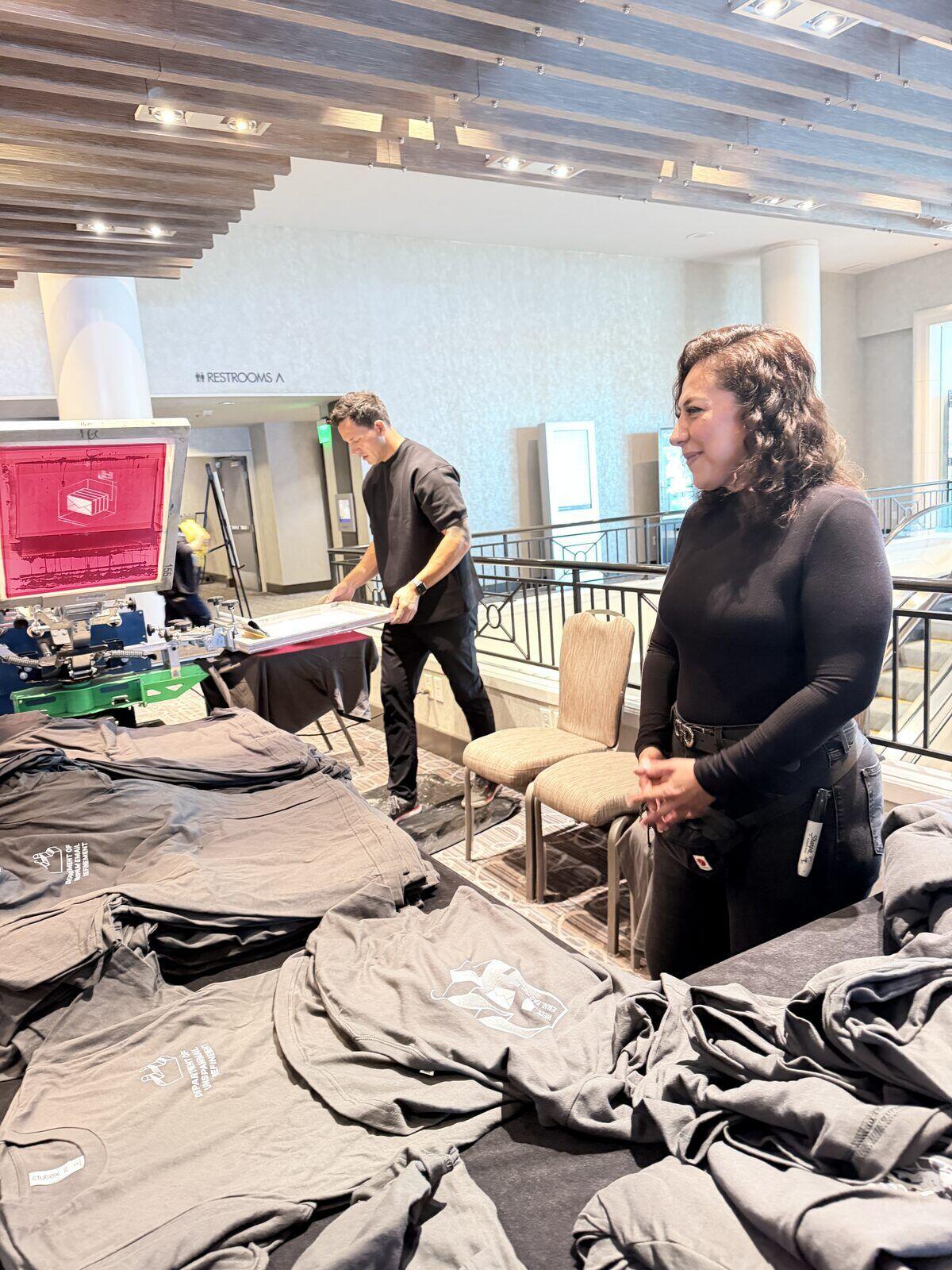
The youth-specific problemsD.2
Size curve
Our guest-facing stock runs adult XS through 3XL, and adult XS carries a lot of the load at a youth event. Where a program needs true youth sizing, that has to be a sourcing decision made weeks out — either from your own inventory or specified in the blanks we buy. It is not something to solve on the floor.
Long surnames on small backs
The roughly nine-character name ceiling is a function of jersey width, and a youth garment is narrower. On small sizes we drop the name height or tighten the ceiling further. Validating the roster before travel is how we catch it, and it comes up more at youth events than anywhere else.
Who is authorized
At youth events the person at the counter is often not the person who paid. We agree with the organizer up front who can approve a ticket, who can request a reprint, and what happens with an unclaimed garment at end of day, so the crew is never adjudicating that in front of a parent.
Overnight, security, and reportingD.3
Between days
The build stays up, which introduces requirements a single-day job does not have. Inventory is counted and secured each night. Presses are shut down properly and re-calibrated in the morning, because a press that sat cold in a hall overnight is not the press you left. Consumables are restocked before doors rather than mid-queue.
Daily report
Each evening you get the day's numbers: units personalized, reprints and their causes, remaining garment inventory by size, unclaimed pieces, and anything needing a decision before tomorrow. Over three days that record is what lets an organizer adjust staffing, reorder a size, or change the cutoff time with actual information.
Travel is free inside Orange County, Los Angeles, and San Diego, and $900 outside that footprint; nationwide tournament programs are quoted with flights, freight, and lodging itemized. Full pricing inputs → Throughput per lane →
Next step
Multi-day bracket coming up? Send the schedule.
Send garment source, unit count, venue, and hours on the floor. We reply with lane count, crew size, and a written figure.